

Our story
A red that has been made the same way for a very long time.

It starts in Fes
In the old city of Fes, aker fassi has never been a trend. It sits on shelves in the medina next to kohl and ghassoul, sold by weight, wrapped in paper. Women buy it before weddings and on ordinary Tuesdays. Nobody calls it a beauty product — it is simply what you use.
We came across it the way most people do: someone opened a small clay pot, wet a finger, and the colour appeared out of nowhere.
Nothing in it is new. That is the whole point.

What is actually in it
It is dried in the sun, ground by hand, and pressed into the clay while still raw. The pigment binds to the pot itself, which is why the colour lifts only when water touches it.
How it is made
-
01
Dried
Laid out in the sun over several days, until all moisture is gone and the colour concentrates.
-
02
Ground
Pounded by hand into a fine powder. Slower than a machine, and the texture is finer for it.
-
03
Thrown
The pot is shaped on a wheel, one at a time. No two are quite the same size.
-
04
Fired
Baked with the pigment pressed inside, so the colour becomes part of the clay.

What we left out
There was a version of this where we put the pigment in a plastic compact, added four shade names and called them a collection. It would have been easier to ship and easier to explain.
We kept the pot. It is heavier, it breaks more often in transit, and it means one shade instead of ten. But the clay is not packaging — it is part of how the colour works.
What we hold to
One product
Until this one is right, there will not be a second.
Made where it comes from
Made in FES
Said plainly
No claims we cannot show you. The colour varies. We say so.

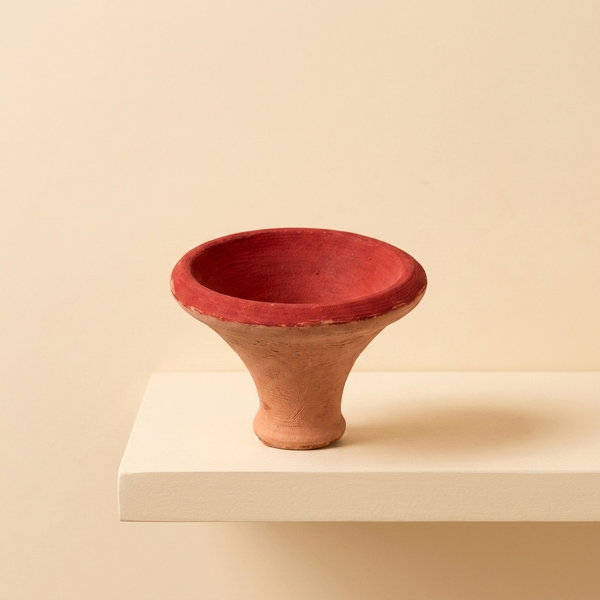
One pot, made by hand
Shop the stain